
Testing Improved Weight Distribution Systems
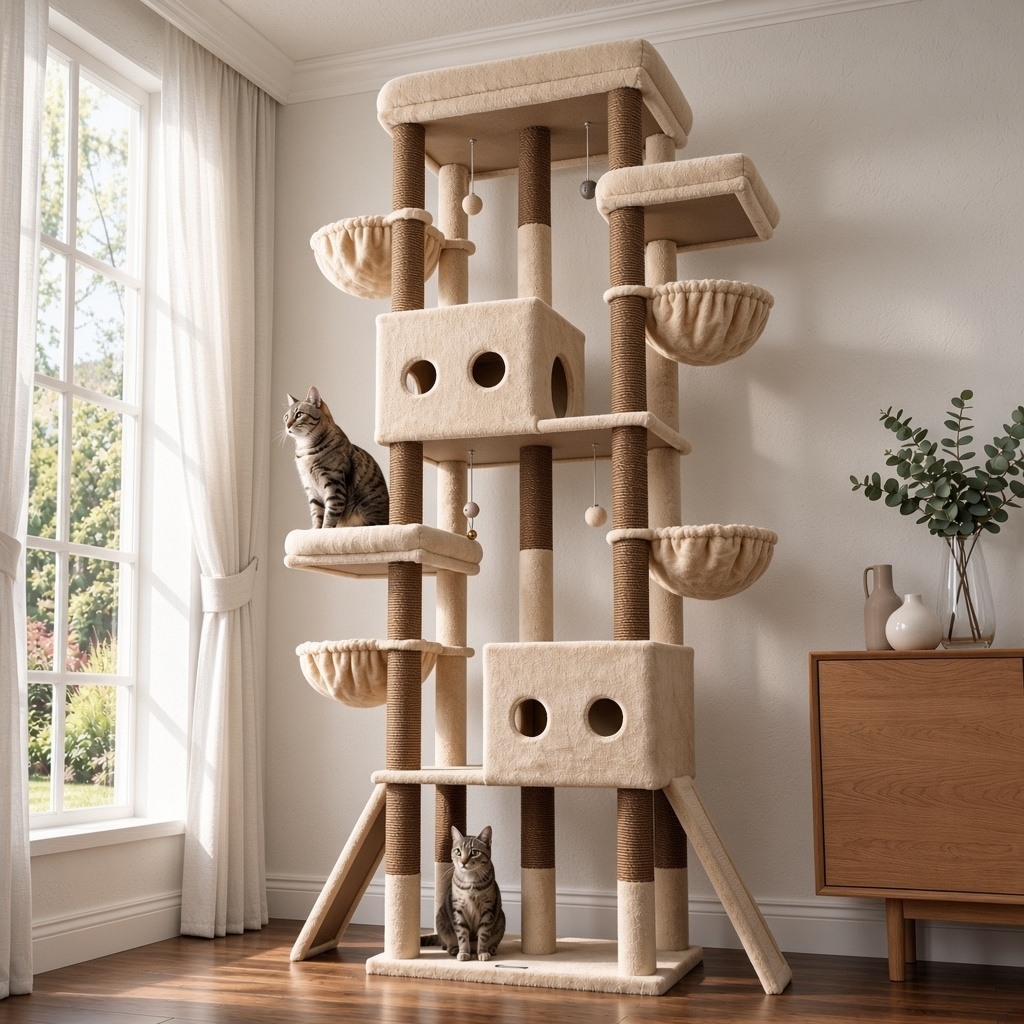
On recent tall cat tree prototypes Globlazer focused on weight distribution—the unglamorous work that decides whether an 80-inch tower feels planted or persuasive. We shifted mass lower in the footprint, revised post offsets on upper modules, and compared how micro-sway changed when a wide platform carried two cats instead of one.
Engineering runs started on paper, then moved to loaded mockups: base plates with adjustable ballast pockets, sisal posts torqued to production spec, platforms weighted to match large indoor cats. The goal was not a lab score—it was whether a hand on the mid-post still felt like reassurance instead of warning.
We mapped where families naturally push when they steady a tower during assembly or when a kitten races the vertical route. That hand pressure rarely hits the base; it lands mid-post. If sway amplifies there, the whole structure reads unstable even when the footprint is correct. Lowering center of mass and tightening upper post offsets reduced that mid-height wobble without widening the base beyond apartment-friendly dimensions.
Dual-cat loading mattered. Wide landings invite two adults to share a sun patch; physics has to accept that social reality. Mockups carried paired weights on the same deck while we measured how force translated to the opposite corner of the base. When mass sat too high, the far corner lifted microscopically—enough for humans to feel doubt. Rebalancing module mass fixed that before we touched upholstery.
Early results fed back into connector and base programs already in flight. When mass sits where the floor can answer it, climb lines stay trustworthy higher up. That is the point of this iteration: quieter physics families feel before they read specs.
Refinements roll into upcoming tall lines through the summer. Same Globlazer neutral palettes—beige, dark grey, light grey—different confidence at the touch.
We recorded hand-pressure points during owner-assisted assembly—mid-post, not base—and used that map to set acceptable sway thresholds. A tower can pass a static load chart and still fail the first human steadying touch; our bar follows the touch.
Upper-module revisions shifted post offsets two centimeters on some decks to pull mass back over the footprint centerline. The visual change is negligible; the change in how a second cat joins the same platform is not.
Summer rollout ties these learnings to connector and base programs already in flight. Neutral palettes stay fixed; what moves is how quickly a family trusts the tower enough to stop gripping the post during kitten races upstairs.
We avoided widening every base to cheat the numbers. Apartment footprints set the boundary; engineering had to solve sway inside that rectangle. The outcome is a tall Globlazer cat tree that feels planted without claiming half the rug.
Loaded mockups will keep feeding modular and single-tower lines through fall. The consumer-facing promise is unchanged: neutral furniture that survives enthusiastic climbs—not specs families must memorize.
Weight distribution is the quiet spec that makes that promise believable at eighty inches and above—felt first at the mid-post, where families steady the tower without thinking. That is the engineering story behind the touch.
New Arrivals
Fresh designs, new colors, and limited releases for modern cat homes.