
Why Stability Shaped Our Early Cat Tree Designs
Early in Globlazer’s development, we kept returning to one uncomfortable truth: cats are excellent structural critics. They do not read spec sheets. They jump once, feel a millimeter of sway, and revise their opinion for months.
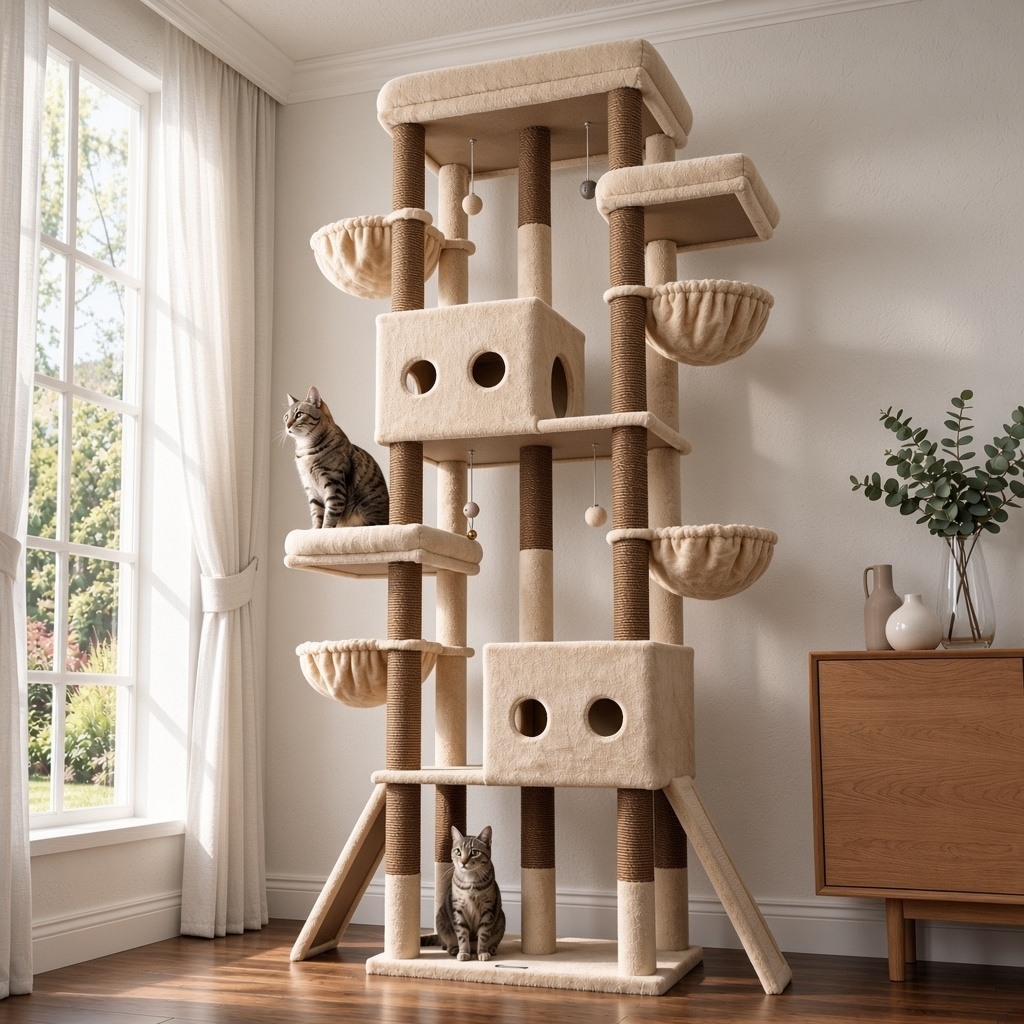
That is why stability was never a late-stage fix for us. It was a design language decision—expressed through base width, post alignment, and how weight travels down the tower when a cat launches to the top perch.
Trust shows up in the first climb
When climbing structures feel uncertain, cats simply stop using them. Owners blame preferences. We saw a simpler pattern in early home visits and sample feedback: the tree that wobbled became a coat rack; the tree that stayed planted became part of morning routine.
So we widened bases before we chased extra height. We adjusted platform overhangs so momentum did not pull the center of gravity outside the footprint. We treated stable cat tree design as the price of entry—not a premium feature.
Those choices cost visual daring. A tower can look more dramatic when it is top-heavy. Cats do not award drama points. They award repeat visits.
We also listened to where humans steady a tower during assembly—usually mid-post, not at the base. Micro-sway amplified at mid-height reads as failure even when the footprint is correct. Lowering effective center of mass and tightening post offsets addressed that touch point before we chased taller silhouettes.
Dual-cat loading shaped platform decisions, too. Wide landings invite shared sun patches; physics has to accept two adults on one deck. Early mockups with paired weights showed when a far corner lifted microscopically—enough for a person to doubt the whole structure. Stability work was social as well as structural.
Sisal posts received the same discipline. A wrap that loosens under claw traffic changes how force travels up the column. Stable towers treat sisal as part of the load path, not decoration taped on at the end.
By late winter 2023, stability had become one of our non-negotiables alongside neutral finishes and furniture-style silhouettes. Every sketch that followed had to answer a plain question: would you trust this with your cat on the highest level? If the honest answer was no, the drawing went back to the board—not to a lab report, but to the same iterative conversations that built Globlazer in the first place.
Neutral finishes complicated the stability story in a useful way. Slim beige upholstery can hide how much mass sits in the base. We resisted slimming footprints for photography when sample feedback said cats hesitated on the third hop. Stability and calm color had to arrive together.
Assembly sequence became part of stability, too. Towers that wobble on first build erode confidence before a cat climbs. Early Globlazer instructions stage heavy base modules first, then widen upward—so the structure feels planted while hands still steady the mid-post.
Stability is invisible when it works. That is the compliment. A cat tree families stop thinking about is usually a tower that earned trust on the first climb and kept it through years of enthusiastic jumps.
New Arrivals
Fresh designs, new colors, and limited releases for modern cat homes.