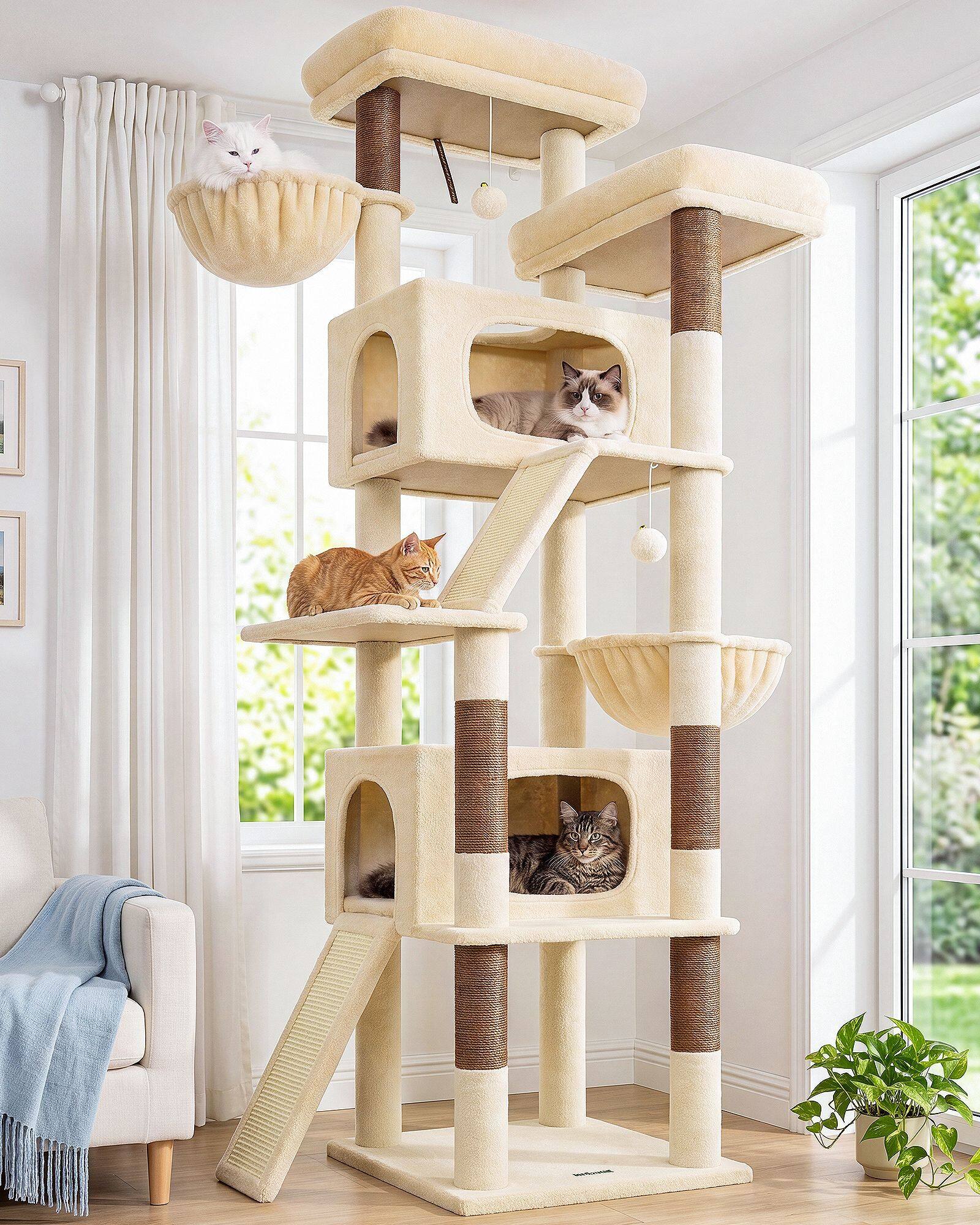

Early Sketches From Our Modular Cat Tree Concept
Before Globlazer had a catalog, we had vocabulary. Not marketing language—structural language. Base footprint. Post spacing. Platform depth. Hammock clearance. Each word mapped to a decision that would later show up in a living room, whether or not a customer ever noticed the engineering behind it.
Our earliest modular cat tree sketches treated those pieces as separate problems first. We drew bases at different widths on the same page. We compared two post distances with identical platform sizes. We asked what happened if the top rest unit swapped from a hammock to an enclosed perch without redrawing the whole tower.
Modularity, for us, was not about selling add-ons on day one. It was about learning faster. When you can rearrange modules on paper—and later in rough mockups—you see conflicts early: a platform that looks generous but blocks a window sightline, or a slim base that photographs well but feels hesitant when a cat lands hard on the third level.
The sketches also forced a shared internal grammar. Designers, sample builders, and logistics planners could point to the same labeled parts instead of describing “the middle thing.” That grammar still shows up in how we name iterations today.
Some pages never became products. That was the point. A modular concept lets you discard a bad platform without mourning an entire tree. The survivors—proportions we trusted, clearances cats actually used—moved forward into taller structures we would introduce later in the year.
We annotated climb lines on many sheets—not cute arrows, but paw paths. Where does a cat enter sisal? Where does momentum want to go after the second hop? Modular thinking exposed how often a beautiful stack fought those paths because a platform lip sat half an inch wrong.
Material notes lived beside structure notes. A hammock module needed different clearance than a plush disk; sisal posts needed diameter choices that would not bully adjacent upholstery. Modular sketches let us compare those pairings without committing to a full tower sample every time a post wrap changed.
Logistics entered the conversation earlier than expected. Flat-pack logic rewards repeated part sizes. When two platforms could share a post spacing family, cartons got simpler and assembly instructions got calmer. Modularity was not only a design studio habit; it was a way to keep early Globlazer programs coherent as SKUs multiplied.
We kept a discard pile beside the desk—platforms that looked elegant alone but fought each other in stack. Modularity made failure cheap. A bad hammock clearance could die on page four without killing a base we already trusted.
Customer language entered late in the sketch phase, translated into structure. When early readers said a tower felt tall but narrow, we traced that to post spacing, not marketing copy. Modular sheets let us adjust one variable while holding others constant—closer to how cats experience change than swapping entire prototypes.
Looking back at those early sheets, what stands out is not a single hero drawing. It is the repetition: base, post, platform, rest—explored in combinations until the stack felt inevitable. The modular cat tree idea was never about infinite parts. It was about disciplined parts that could recombine without surprising the room—or the cat.
New Arrivals
Fresh designs, new colors, and limited releases for modern cat homes.