
Why Stability Became Our Top Engineering Priority
Early Globlazer sketches chased height because height photographs well. The harder lesson arrived in assembly rooms and living rooms: owners forgive a quiet silhouette. They do not forgive a nervous one. A cat tree that looks impressive in a frame but shifts under a shoulder check loses trust before the first week ends.
By 2024, stability had become our top engineering priority—not as a marketing phrase, but as the first question in every structural review. Before we discuss fabric direction, platform count, or how a tower reads beside a linen sofa, we ask whether the frame will stay planted when real cats use it the way real cats always do: abruptly, repeatedly, and often from opposite directions at once.
Large indoor breeds changed the math. Platform sizing that felt generous for an agile medium cat behaved differently under the turning weight of a heavy breed settling in for a long nap. Our product team began modeling how load lands during a pivot, not only during a posed stillness on a product page. That shift pulled attention toward base width, column alignment, and the way upper levels transfer motion downward through the whole silhouette.
Multi-cat traffic multiplied the problem in a different register. One climber is a load. Two cats passing on different levels are a rhythm—and rhythms expose weak geometry faster than a single dramatic leap. Engineering notes started tracking how staggered platforms, bracing placement, and perch spacing reduce sway when daily traffic moves in opposite directions. Stability, for us, became a story about repeated use: morning launches, midnight descents, and the small corrections cats make with their shoulders when they decide whether a tower is worth trusting again tomorrow.
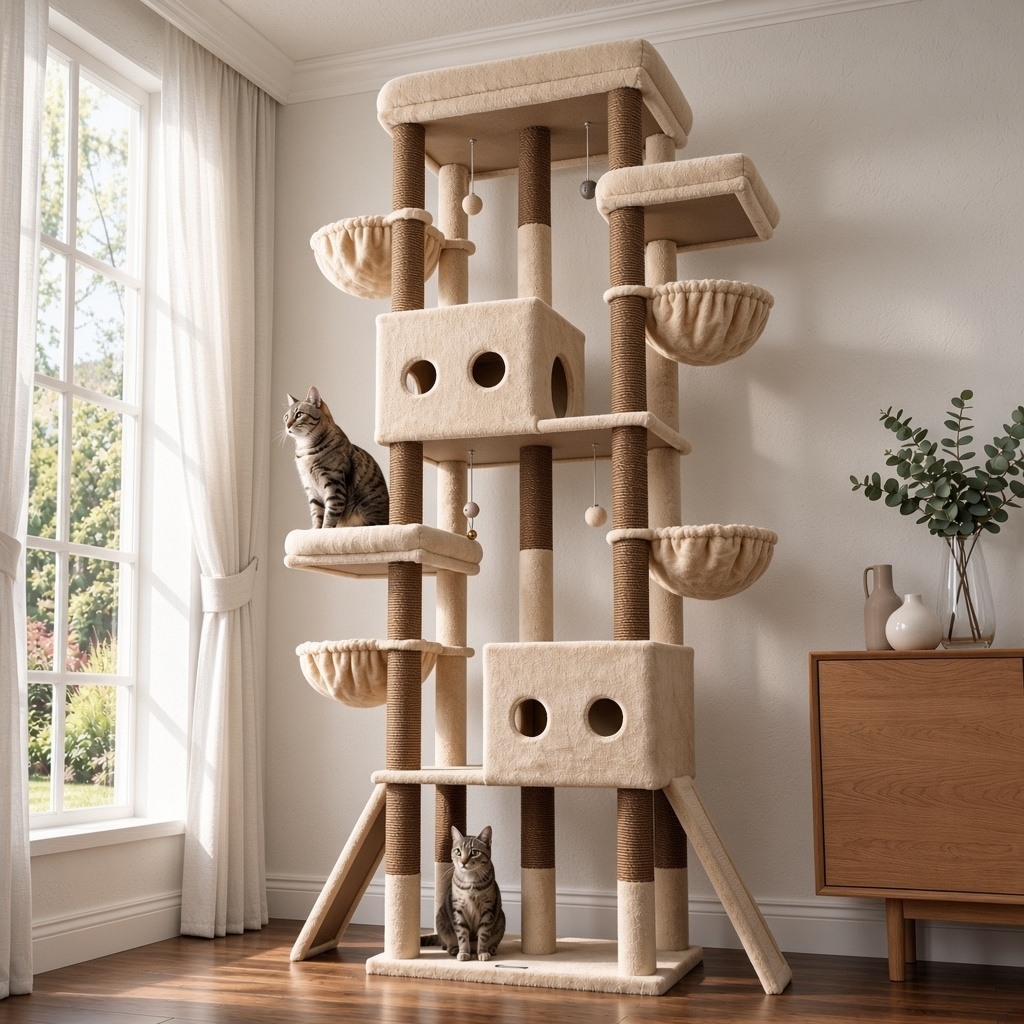
Those conversations also changed how we talk about height. Extra-tall cat trees remain part of the Globlazer line because vertical space matters in modern homes. But height without a believable foundation reads like decoration. We began pairing taller profiles with wider footprints and calmer upper massing so the eye still travels upward while the floor receives a steadier answer. Owners may never study a structural sketch, yet they recognize the difference immediately when a tower stops asking for doubt.
Reinforced metal connections, wider foundations, and edited upper profiles were not isolated fixes. Together they became a design language: planted at the floor, calm in the middle, open at the top. That language now travels across room-scale towers and compact vertical solutions alike. The goal is not to make every cat tree look the same. It is to make stability feel consistent—something you sense in the ankles when you brush past a post, something a cat reads in the whiskers before committing to the highest perch.
Today, no Globlazer style ships without answering the same sequence. Does the base look believable before the first climb? Do platforms support real turning weight, not only a careful demonstration? Does the structure stay quiet while the room keeps living around it—vacuuming, guests, children, the ordinary motion of a home that was never designed around a photo shoot?
That sequence is why stability sits above accessory count, seasonal color drama, or silhouette novelty in our engineering queue. A modern cat tree should feel trustworthy on day one and still feel planted on day three hundred. For a cat tree specialist serving Europe and North America, that feeling is not a side feature. It is the product.
New Arrivals
Fresh designs, new colors, and limited releases for modern cat homes.