
Furniture-Inspired Cat Trees vs Traditional Designs
Cat trees split into two philosophies that rarely share a room well. One treats the tower as pet equipment. The other treats it as vertical furniture. The gap shows up in silhouette, color, footprint, and whether the object survives a living room sightline for more than a season.
Traditional design routes
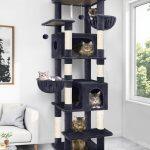
Traditional cat trees often win attention with novelty: faux branches, carpeted boxes in primary colors, shapes that read clearly as pet aisle. In a spare room, that clarity can be charming—cats climb, owners laugh, nobody minds the visual noise behind a closed door.
Beside a neutral sofa, the same logic often fails. Traditional routes tend to spread horizontally: wide bases, bulky condos, multiple small boxes that add enrichment by adding objects. In open-plan rentals, that approach taxes walkways and visual calm at the same time. The tower becomes a visitor that never learned indoor manners, even when cats adore it.
Traditional design also leans on pet symbols—paw prints, bright carpet, dangling toys that clutter the silhouette. Those cues help in a dedicated pet corner. They fight modern interiors built on edited objects and one coherent palette.
Furniture-inspired cat trees
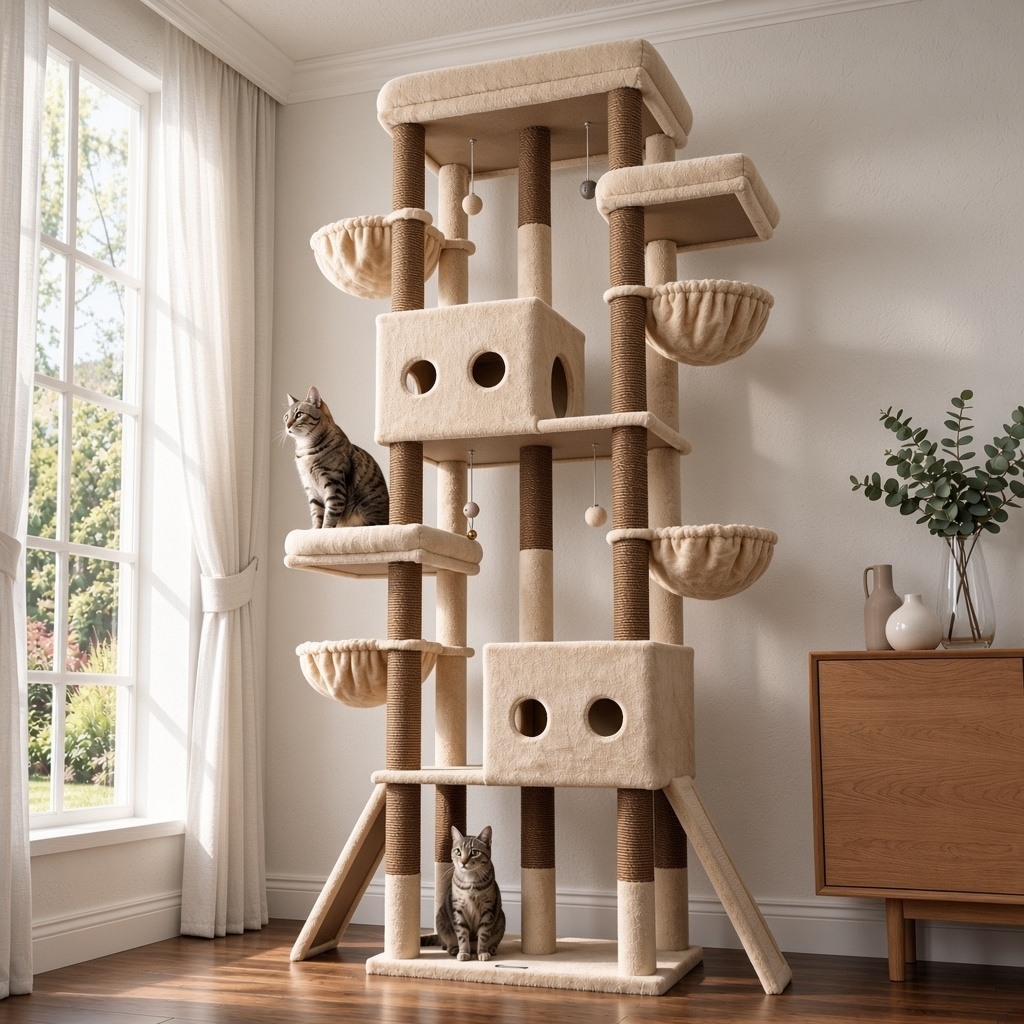
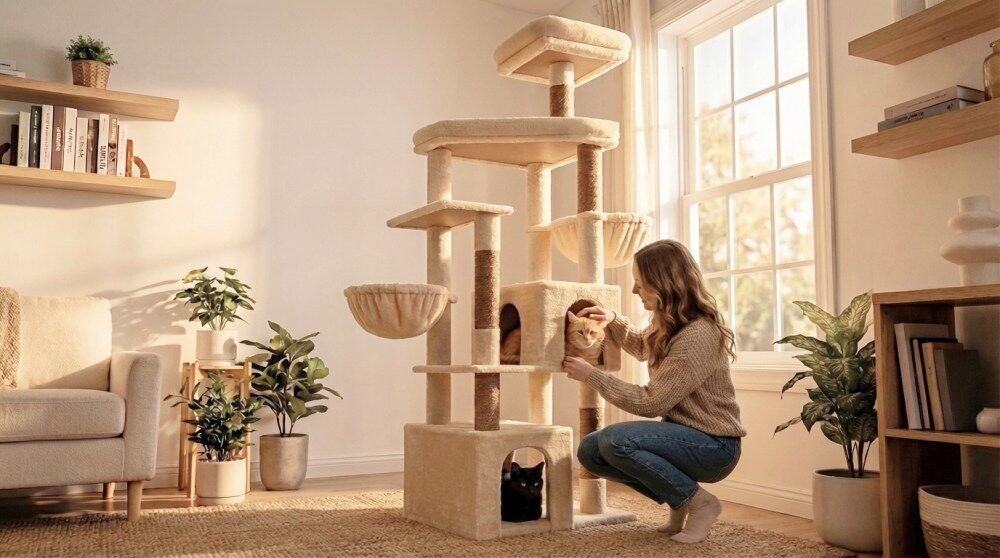
Furniture-inspired cat trees borrow a different rulebook. Edited silhouettes, warm neutrals, platforms sized like ottomans, sisal treated as texture rather than decoration. The goal is not to hide that cats live here—it is to keep the tower from dominating the photo.
That lane borrows upholstery logic: calm color, believable proportion, nothing that screams impulse aisle. Slim columns above wide bases echo floor lamps and cabinetry. Plush is chosen to sit beside throw blankets; wood tones align with floors already in the room.
Market shift tracks housing reality. As more households live in open kitchens and mobile rentals, owners reward vertical structures that stay slim. One calm tower replaces three loud pieces. Industry Updates observation describes the scorecard simply: fewer objects, higher standards, longer stays in the room.
Placement tells the story in real homes. Traditional towers often migrate to spare rooms after the first month beside a curated sofa. Furniture-inspired towers stay because they pass the guest test—people ask if the object is furniture before they ask if the cat likes it.
Performance did not get easier in the furniture-inspired lane. Calm looks still need wide enough bases, honest plush, and posts that recover after real launches. The difference is priority: stability first, then proportion, then ornament—often ornament deleted entirely. Soft minimalism did not repeal physics; it just stopped pretending decoration could substitute for engineering.
Neither philosophy is wrong for every cat. But modern interiors vote with placement. Furniture-inspired Globlazer cat trees keep appearing in living room sightlines because they answer a newer question: can this object stay for years without feeling like a compromise?
Engineering visibility changed as well. Wide bases on furniture-inspired towers signal trust without faux bulk; traditional spreads sometimes hide wobble behind decorative mass that cats distrust anyway.
Scratch surfaces tell the difference too. Furniture-inspired posts expose sisal as weave; traditional towers often hide function behind molded carpet that ages unevenly in living light.
Multi-cat homes sharpen the contrast. Traditional spreads eat floor; furniture-inspired routes stack vertically beside the sofa, preserving walkways while giving each cat a perch.
Longevity is the hidden metric. Traditional towers often leave the living room after the first redecorate; furniture-inspired Globlazer cat trees are chosen precisely because owners expect them to survive sofa swaps and rug changes without another purchase cycle.
That question is replacing the older one—can this object entertain a cat—because entertaining cats and respecting rooms stopped being separate jobs. When cat trees graduate from pet equipment to vertical furniture, the comparison is not about novelty. It is about whether the room and the cat can both win.
New Arrivals
Fresh designs, new colors, and limited releases for modern cat homes.